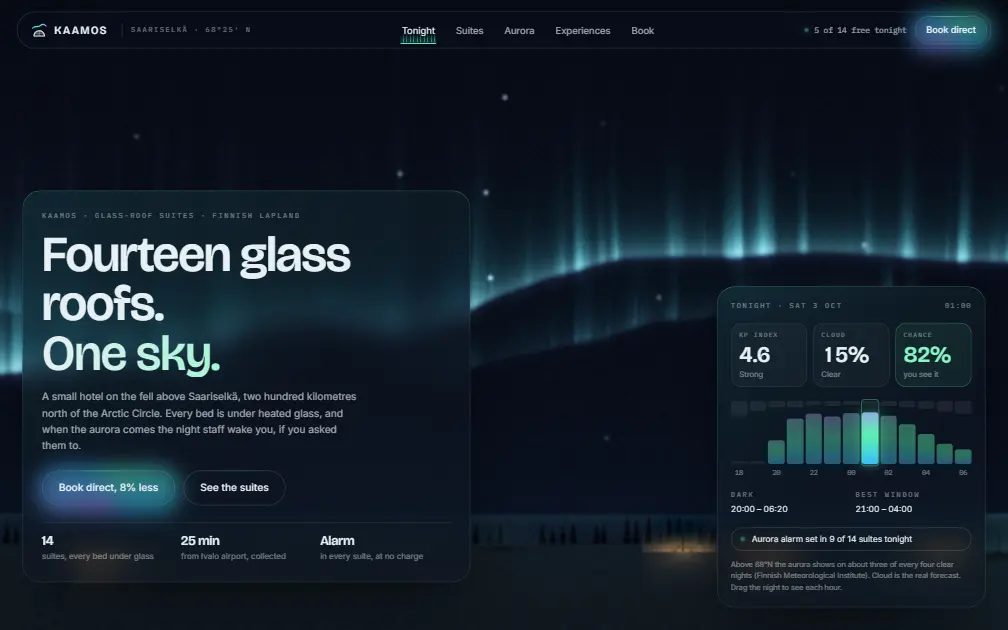
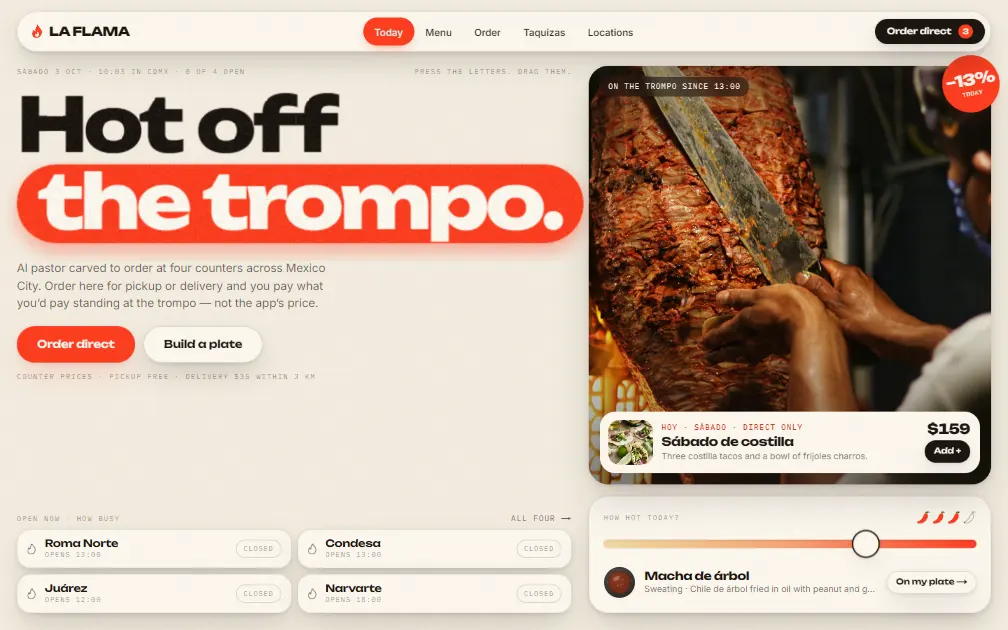
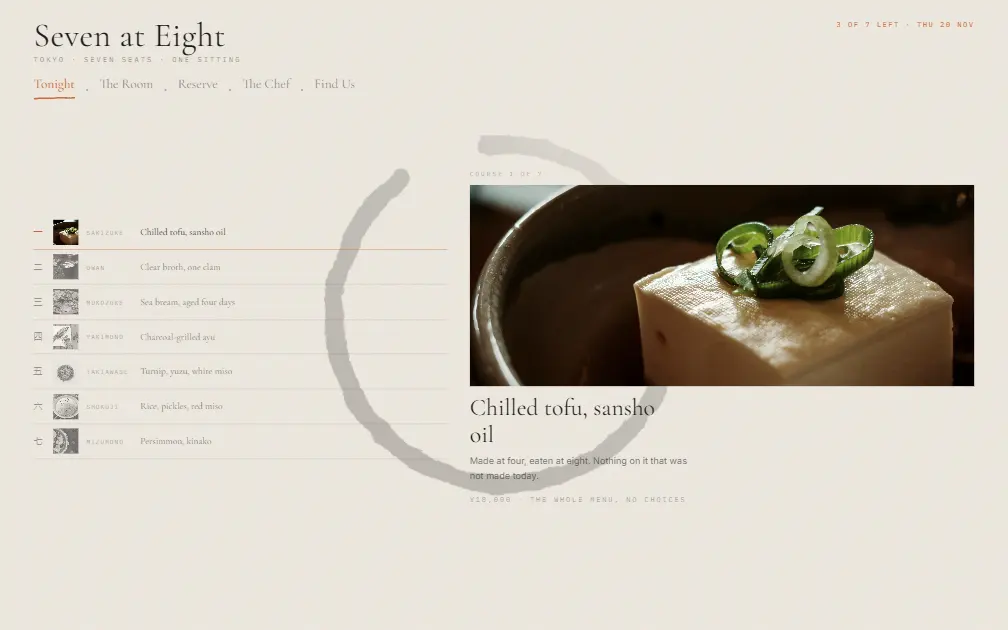
The example: OSTRO, a small-group tour operator in Lipari
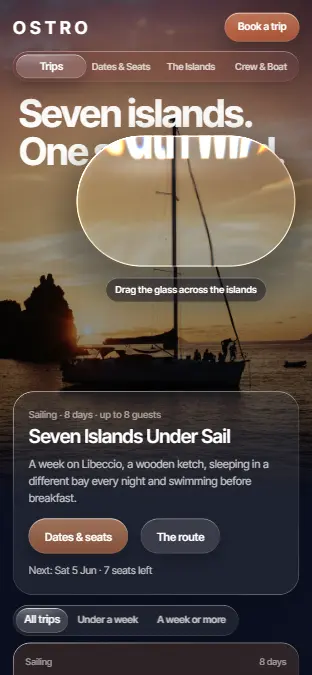
OSTRO is a small-group tour operator in Lipari we invented to show what we build for this trade — every page above works. Liquid glass · a lens that bends the islands behind it.
What a tour operator website has to do
Most travellers meet a small operator on a marketplace, then go and look it up. What they find is usually a gallery of sunsets, a trip list with "Enquire" on every line and no dates in sight, so they go back to the marketplace to book, and the commission comes out of a trip the operator already sold.
A tour operator’s website has a few jobs: show the trip as the reason to go, put every departure on the page with the seats still left, show the route day by day, introduce the people who run it, and take a deposit with the terms written plainly enough that nobody has to ask what happens if they cancel.
That is what we build for tour operators, sailing charters, and walking and food trips. OSTRO, above, is the example: an Aeolian Islands operator whose first screen is a lens of glass you drag across the islands, whose departures count their seats down as you add guests, and whose booking takes 25% and spells out the rest.
In 2025, operators’ own websites took 25% of tour and activity bookings, down from 29% the year before, while online travel agencies rose to 37%.
Source: Arival Global Operator Landscape, 2025Airbnb charges a 20% service fee on experiences, and GetYourGuide told some operators in 2025 that their commission was rising from 20% to 30%.
Source: Airbnb Help Centre; Arival, 202548% of US and 46% of European day-tour takers chose tours of fewer than seven people.
Source: Arival Day Tour Taker study, 2026
- 01
The trip as the reason to go
The places and the days first, not a stock sunset and a search box. Each trip with its length, its group size and what it costs.
- 02
Every departure, with the seats left
A calendar of departures for each trip, with seats left on each one and a waitlist when one fills. Seats left is what sells a small-group trip.
- 03
A deposit, not the full price
Book with a deposit and pay the balance later, with the dates and amounts worked out on the page before anyone commits.
- 04
The route, day by day
Where you sleep, where you walk, how you get between them, on a map that shows the whole trip at once.
- 05
The people who run it
The skipper, the guides, the cook, and the boat or the house. Travellers book a small group because of who is leading it.
- 06
Cancellation, said plainly
What you get back at each point before departure, laid out as a ladder next to the button, so the deposit reads as safe.
The example, page by page
01Trips
Five trips over the islands they visit, with a lens of glass to drag across the photograph and the headline.
02Dates & Seats
Every 2027 departure by month, with seats left; add guests and the seats count down, with the deposit and balance worked out.
03The Islands
The seven islands drawn to scale, each trip’s route lit across them, and the itinerary day by day.
04Crew & Boat
The skipper, the guides and the cook, and Libeccio’s deck plan with each cabin to tap.
05Book
Trip, departure and guests, a cancellation ladder, and a 25% deposit with the balance date spelled out.
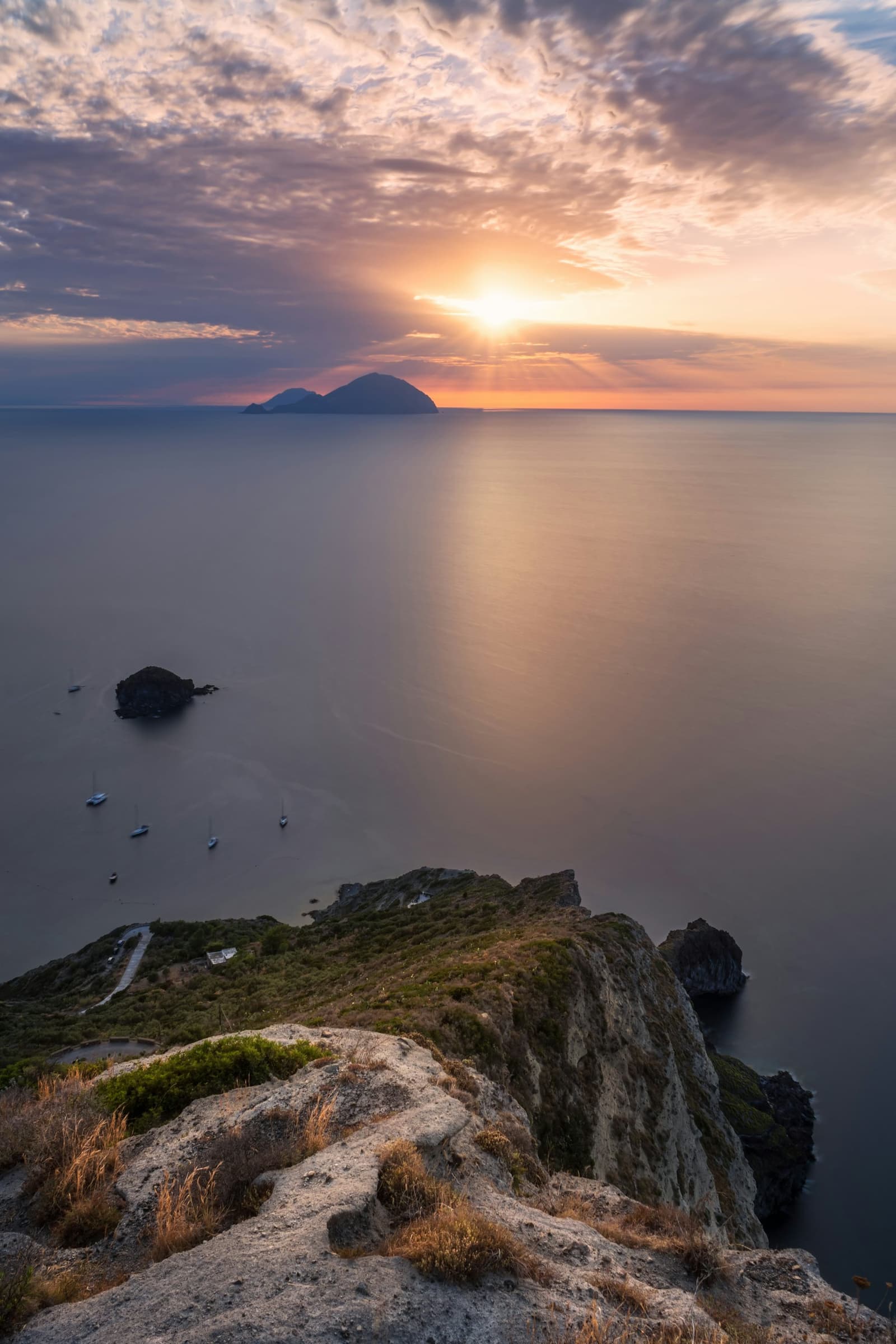
Seats sold direct, not on commission
Built to move bookings off the marketplaces and onto the operator’s own site. A direct seat costs a percent or two in booking fees instead of a fifth or more in commission, and a traveller who has seen the route, the boat and the seats left books with a deposit, not a question.
How we build it
- Days 1–4
Your trips
Trips, departures, prices, deposit rules and the booking engine you use or will use.
- Days 5–14
The pages
The photography, the map and every page designed, phone first, since that is where most travellers look.
- Days 15–20
Live
Availability, deposits and payments connected, tested on real departures, and launched.
What a tour operator website costs
$5,800–$8,200
16–20 days to live · fixed price, agreed before we start · branding included
What moves the price
- How many trips and departures
- Your booking engine connected
- Deposits, balances and waitlists
- More than one language
After launch, hosting, uptime, security and monthly reporting run from $250 a month: a monthly retainer, never a contract term.
Questions we get asked
How much does a tour operator website cost?+
Ours run from $5,800 to $8,200, fixed and agreed before we start. The range is set by how many trips and departures there are, which booking engine we connect, and how many languages the site speaks. Specialist travel agencies commonly quote more and take two to three months.
How long does it take?+
Sixteen to twenty days from the first call to live, including test bookings on real departures before launch.
Do you work with our booking engine?+
Yes. We design the departures, seats and deposits around the engine you already use, so availability stays in one place. If you do not have one, we will help you choose; most charge a percent or two to three per booking, against a fifth or more on a marketplace.
Should we stop selling through the marketplaces?+
No. They are where many travellers find you. The point of your own site is that the ones who look you up afterwards book with you, and the ones who come back next year do too.
Can we update trips and departures ourselves?+
Departures and seats come from your booking engine, so they update themselves. Trips, itineraries, photographs and crew are yours to edit without a developer.
Is OSTRO a real operator?+
No. OSTRO is an Aeolian Islands operator we invented to show what we build for tour operators. Every page works as a design you can try; availability, deposits and payments are what we connect to your booking engine at build.