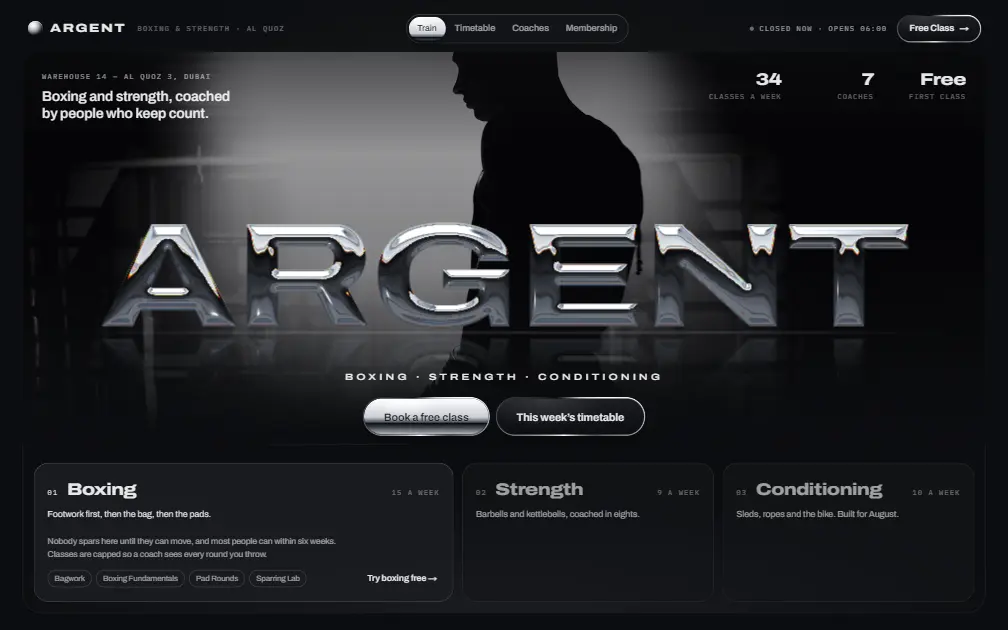
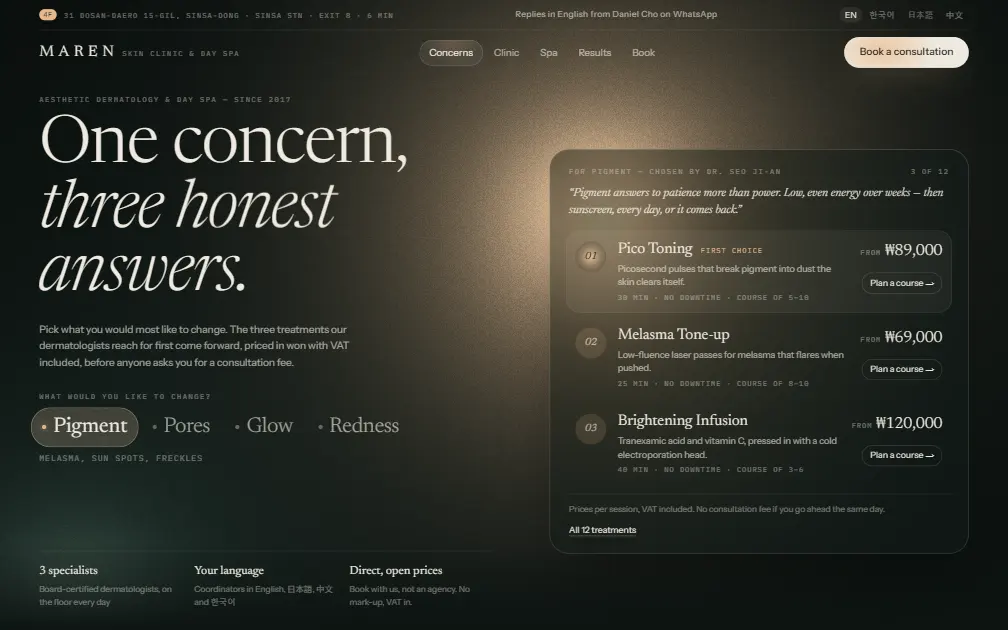
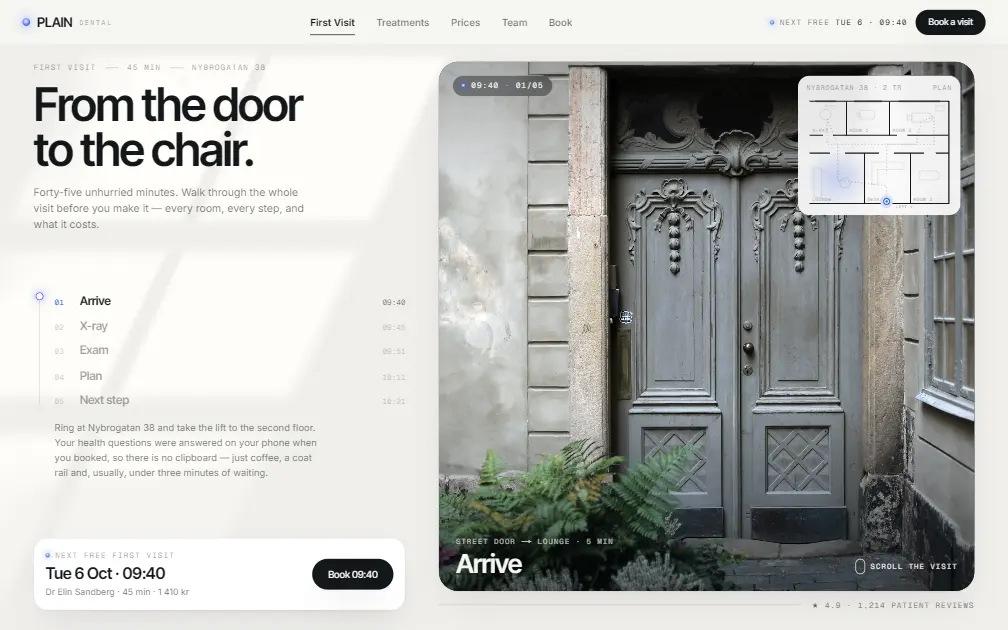
The example: HOLLOWAY & SON, a barbering house in London
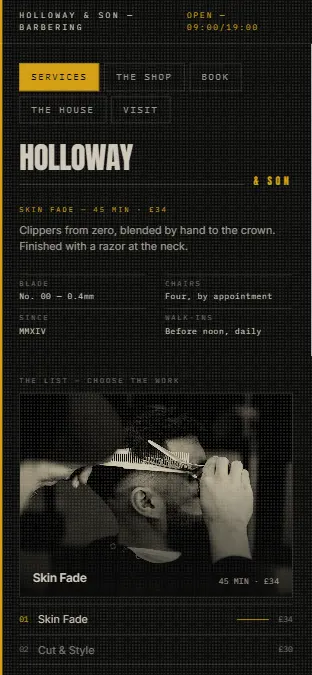
HOLLOWAY & SON is a barbering house in London we invented to show what we build for this trade — every page above works. Industrial brutalism · dithered halftone.
What a barber website has to do
A new customer finds a barber the same way every time now: a search on their phone, a look at the cuts, a glance at the prices, then either a booking or the back button. Good barber website design is built for that minute. It answers what a stranger wants to know before they let you near their neck: what you do, what it costs, who does it, and when they can come in.
Most barbershop websites lose them at the last step. The prices are a photo of the board. The booking sits in an app under somebody else’s logo, one swipe from the shop down the road. Choosing a barber means ringing a shop where everyone has clippers in hand. And when someone does book, nothing reminds them, so the chair stays empty at half four.
So our barbershop website design starts with the chair, not the homepage. Services and prices you change yourself. Every barber shown with their days and what they are best at. Booking that writes straight into the system you already run, with deposits and reminders if you want them. HOLLOWAY & SON, above, is the example: four chairs in East London, and a way to book from every page.
71% of salon regulars have decided not to book because it was too hard to reach someone or book online.
Source: Zenoti Salon and Spa Consumer Survey, 2025Across 181,180 barbershop appointments on one booking platform, 77.49% were booked online.
Source: Mangomint booking data
- 01
Prices on the page, not on the wall
Every service with its length and its price, written the way you would say it at the chair. A customer who can see a skin fade is £34 and forty-five minutes books it. One who has to ask often does not.
- 02
Every barber, bookable by name
Regulars come back for a person, not a shop. Each barber gets a chair, a year and the work they are known for, so a new customer can find the one who does curls, or the razor.
- 03
Booking in three choices
A barber booking website should ask three things: a day, a time and a chair. Taken slots are struck out, no account is needed, and on your site the booking lands in your real calendar.
- 04
The next free slot, one tap away
Each barber’s card shows the days they cut and their next free slot. One tap opens the booking with that day, that time and that barber already chosen, so there is nothing left to decide.
- 05
Rules that stop no-shows
Cancellation and lateness rules stated plainly before anyone books, so nobody can say they did not know. On your site we back them with a deposit or a card on file, and a reminder the day before.
- 06
Walk-ins sent at the right hour
Opening hours, when walk-ins stop, and how busy a typical week gets, hour by hour, so walk-ins arrive when a chair is free. Plus the door, the address and the walk from the station.
The example, page by page
01Services
Four services, each with its length, its price and a line on how it is done. Pick one and the photograph and description follow, and it carries through to the booking summary.
02The Shop
The room and the four people in it. Pick a barber to see their chair, the year they started and what they are known for. The choice follows you to Book.
03Book
Book a chair in three steps: a weekday, a time and a barber. Taken slots are struck through, and the summary adds up the service, length and total before you confirm.
04The House
Father and son, forty-three years of it, and a card for every barber with their days, speciality and next free slot. One button opens Book with that slot already chosen.
05Visit
Address, hours, walk-in rules and the route from three stations, drawn on a street plan. A chart of a typical week shows how busy each hour gets, and when to walk in.
Fewer no-shows, fewer calls
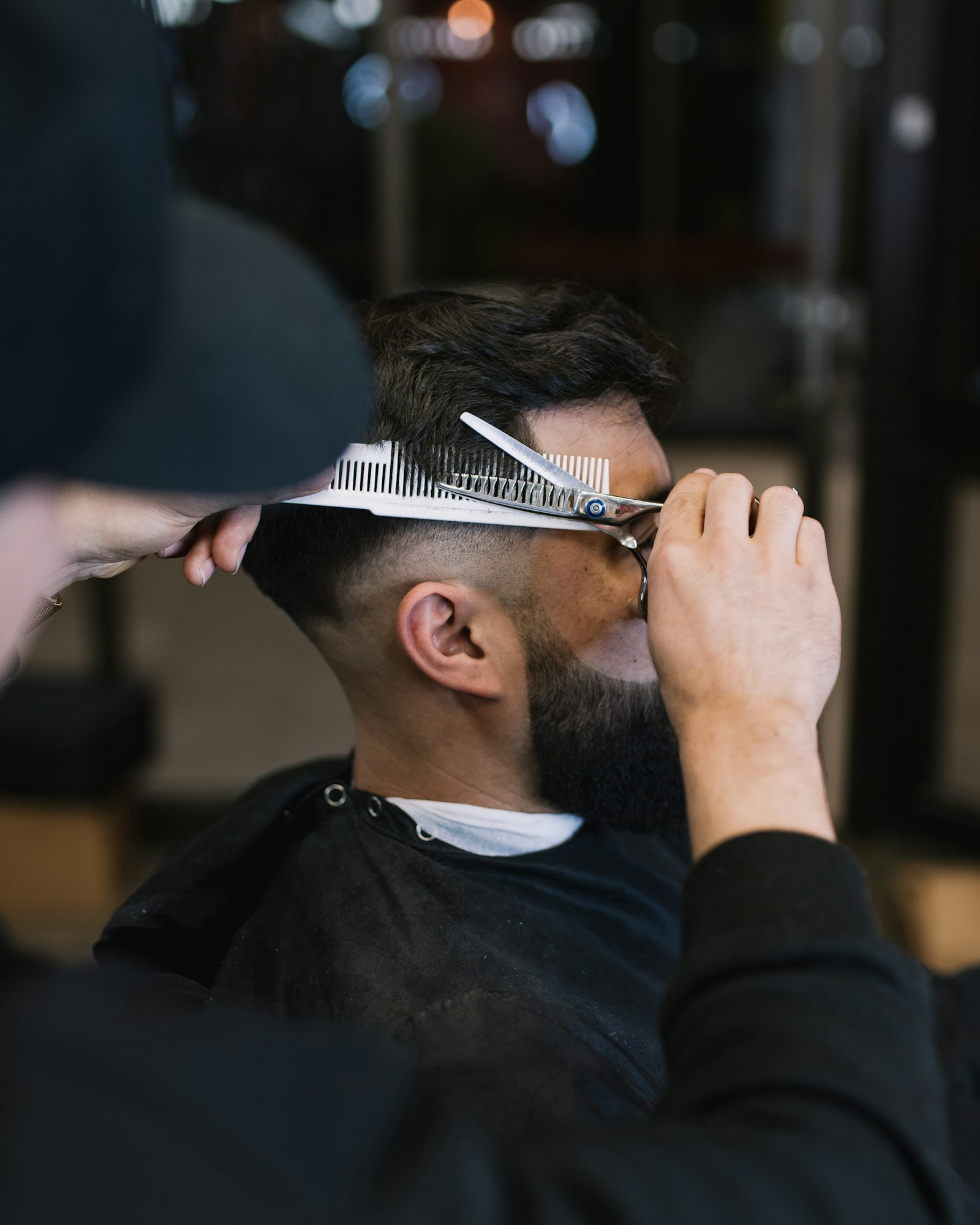
Built to move bookings off the phone and into the calendar. A deposit at booking is what cuts no-shows, and a chair the customer picked themselves is one they tend to turn up for.
How we build it
- Day 1
The board
Services, prices, barbers and hours go into one place, with your rules for deposits, lateness and walk-ins.
- Days 2–4
The look
Design and a photo treatment that makes your own shoot, or your own phone, read as art direction rather than a snapshot.
- Days 5–8
The chair
Booking connected to the system you use, deposits and reminders switched on, tested by your barbers on their own phones, then live.
What a barber website costs
From $2,400
5–8 days to live · fixed price, agreed before we start · branding included
What moves the price
- How many barbers, and how many shops
- Connecting the booking system you already use
- Deposits, card holds and reminder texts
- Selling products or gift cards online
After launch, hosting, uptime, security and monthly reporting run from $250 a month: a monthly retainer, never a contract term.
Questions we get asked
How much does barber website design cost?+
Our barber sites start at $2,400, fixed and agreed before we start. That covers the design, every page, booking connected to your system, branding and two rounds of revisions. The price moves with the number of barbers and shops, whether you want deposits or card holds, and whether you sell products or gift cards online. You see the exact figure before you commit to anything.
How long does it take?+
Five to eight days from the first call to live. Day one we gather your services, prices, barbers and hours. The next few days are design. The last are booking, deposits and reminders, tested by your barbers on their own phones before launch. The timeline depends on how quickly you send feedback, so the faster you reply, the sooner it is live.
Will it work with Booksy, Fresha or Square?+
Yes. If your chairs already run on Booksy, Fresha, Square Appointments, Vagaro or similar, we keep it, so your client history, reminders and payouts stay where they are. Your website becomes the front of it, with booking from every page. If you are starting fresh, we will recommend a system that fits a shop your size and set it up with you.
Can I change prices and barbers myself?+
Yes. Services, prices, barbers and opening hours are yours to edit, from your phone, without calling us. Most shops change something every month: a new barber, a holiday, a price rise in January. None of that should need a developer. If you would rather not touch it, we can handle small changes for you on a monthly plan.
Can a website really cut no-shows?+
Most of the work is done by three things: a deposit or card taken at booking, a cancellation rule stated before anyone books, and a reminder the day before. All three live in your booking system, and the site is where customers meet them first. The example states its rules on the Visit page; on your site we switch the deposit and reminders on too.
Do I need a website if I already have Instagram and a booking app?+
Instagram shows the work and an app takes the booking, but neither is yours. Both put other shops one swipe away, and neither tells your story, your prices and your barbers in one place. A barber shop website is what a new customer checks before trusting you with a fade, and it gives Google one clear page about your shop and your area.
Is HOLLOWAY & SON a real barbershop?+
No. HOLLOWAY & SON is a barbering house we invented to show what we build for barbers. The address, the barbers and the prices are made up. Every page works: pick a service, a barber, a day and a time, and the booking adds itself up. Nothing you enter is sent anywhere. On your site, the same flow writes into your real calendar.
Do you build websites for barbers outside the UK?+
Yes. We are a remote studio and build for barbers in the US, the UK, Europe and Australia. Everything happens over a call and a shared preview, so where you are makes no difference. You get a free design preview within 48 hours of getting in touch, before you pay anything, so you can judge the work before you commit.