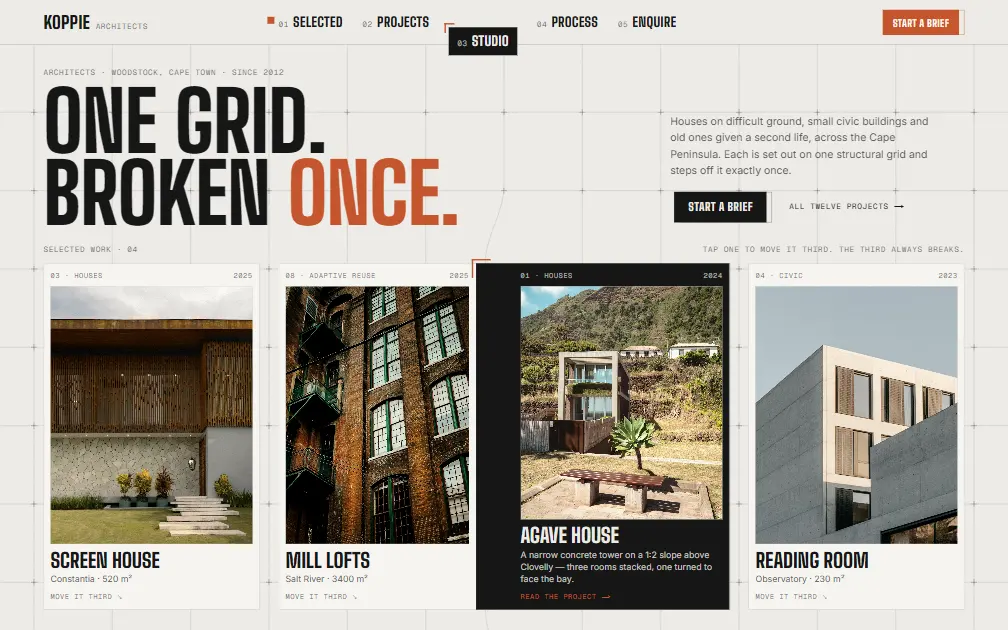
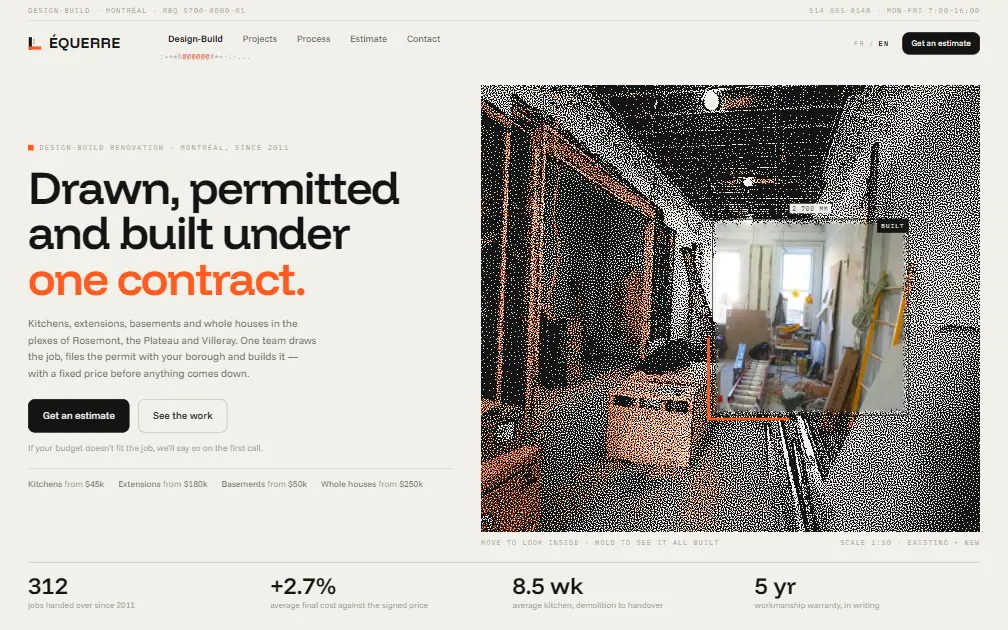
The example: EQUINOX ESTATE, a property house in New York
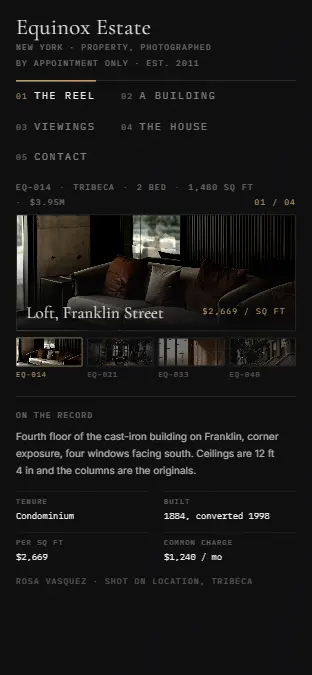
EQUINOX ESTATE is a property house in New York we invented to show what we build for this trade — every page above works. Cinematic · anamorphic frames, slate data, one grade.
What a real estate website has to do
A property buyer has already scrolled the portals by the time they reach you. What they come to your own site for is the thing the portals cannot give them: a sense of the house, the building, the people — and a way to see it in person without filling in a form that disappears into a shared inbox.
So a real estate website has two jobs. Sell the property properly, with photography and data that make it feel like the only one, and turn interest into a booked viewing with the right agent. Everything else — the about page, the market report, the blog — exists to support those two.
That is what we build: a listing schedule you update yourself, a record for every unit with its real availability, and viewing requests that land in an agent’s diary rather than an inbox.
For 43% of recent buyers the first step was looking at properties online, and 51% found the home they bought on the internet.
Source: National Association of Realtors, Generational Trends Report, 2025Most buyers start their search online, yet 43% used an agent they found through a referral.
Source: NAR Profile of Home Buyers and Sellers 2025, via Virginia REALTORS
- 01
Listings that sell the property
Every listing art-directed, not dropped into a grid: one grade across the photography, and the numbers set where a buyer looks for them.
- 02
Live availability, unit by unit
For developments and buildings, each floor and unit with its own record — price, size, status — so nobody enquires about something already gone.
- 03
Viewings booked straight into a diary
A buyer picks a time that is actually free, and the viewing lands with the agent who handles that property.
- 04
Agents people want to call
The house and its people, with who handles what, so a lead knows who they are talking to before they talk.
- 05
Enquiries routed to the right person
Buying, selling, letting or valuation — each enquiry goes to whoever owns it, with the property attached.
- 06
A schedule you update yourself
New instructions, price changes and sold stamps without calling a developer: the listing schedule is yours to edit.
The example, page by page
01The Reel
The reel: every property as a frame under one grade, with the numbers set like a film slate.
02A Building
One building, six storeys: scrub the elevation and each floor brings up its own record and its live availability.
03Viewings
Pick a free slot and it is held for you with the agent who handles the property. On your site, that slot comes from the agent’s real diary.
04The House
The agency and its agents — who they are, what they handle, and how to reach each one directly.
05Contact
One form that asks what you need first, then routes it to the agent who owns that kind of enquiry.

Booked viewings, not form fills
Built to move more viewings out of fewer, better leads. The filtering happens before the enquiry, so what reaches an agent is a booked viewing with a real person behind it.
How we build it
- Days 1–5
The schedule
Your listings, units and agents go into one structure, with the fields buyers actually filter by.
- Days 6–13
The look
One grade for the photography, the type and every page, designed around your portfolio rather than a stock one.
- Days 14–21
The systems
Availability, viewing booking and lead routing connected and tested with your agents, then launched.
What a real estate website costs
$8,500–$10,000
14–21 days to live · fixed price, agreed before we start · branding included
What moves the price
- How many listings and how often they change
- Unit-by-unit availability for developments
- Viewing booking wired to each agent’s calendar
- Feeds from your CRM or the portals
After launch, hosting, uptime, security and monthly reporting run from $250 a month: a monthly retainer, never a contract term.
Questions we get asked
How much does a real estate website cost?+
Our real estate builds run $8,500–$10,000, fixed and agreed before we start. Where you land depends on how many listings you carry, whether you need unit-by-unit availability for developments, and what we connect it to — your diary, your CRM, the portals.
How long does it take?+
Two to three weeks from the first call to live. The first week is your listings and data, the second the design, the third the booking and lead routing, tested with your agents before launch.
Can I update the listings myself?+
Yes. New instructions, price changes, under offer and sold are all yours to edit, with no developer in between. If you already keep listings in a CRM, we can pull them from there instead.
Will it work with the property portals?+
Your own site and the portals do different jobs, and they can share the same listings. We can feed from your CRM so a property only has to be entered once.
Is the property in the example real?+
No. EQUINOX ESTATE is a New York property house we invented to show what we build for agencies. Every page of it works — the reel, the building scrubber, holding a viewing slot — so you can try the real thing before you talk to us.
Do you write the copy and handle photography?+
We grade and art-direct the photography you have so it reads as one portfolio, and we write or edit the copy for every page. Branding is included in every build at no extra cost.