The example: ORRERY, a demand-forecasting software company in Toronto
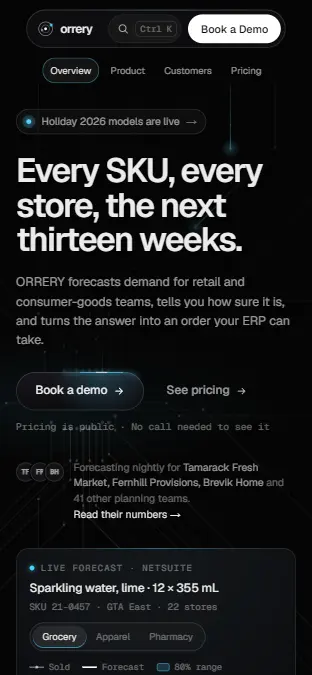
ORRERY is a demand-forecasting software company in Toronto we invented to show what we build for this trade — every page above works. Dark precision · true black, one-pixel hairlines, a light that follows.
What a SaaS website has to do
B2B buyers do most of their deciding before they ever speak to sales. They want to see the product do the thing, check the price on their own and judge whether it fits, and they leave a site that answers with a stock dashboard, a “Contact us” price and a demo form with twelve fields.
A SaaS website has a few jobs: show the product working instead of describing it, let a buyer play with the part that matters, prove it with customers who look like them, publish the price with the maths that justifies it, and book the demo only once the call is worth having.
That is what we build for SaaS, AI and B2B products. ORRERY, above, is the example: a Toronto demand-forecasting company whose forecast runs live on the first screen, whose product page lets you drop a holiday onto the timeline and watch the forecast redraw, and whose demo calendar asks the qualifying questions first.
67% of B2B buyers prefer to buy without talking to a sales rep.
Source: Gartner, via Digital Commerce 360, 2026Transparent pricing has been tech buyers’ number-one wish from vendors four years running, and 83% shortlist three products or fewer.
Source: TrustRadius B2B Buying Disconnect, 2026 (n=1,862)
- 01
The product, working, on screen one
Not a screenshot. The product’s core output running in the page, so a buyer understands it before they read a word about it.
- 02
A demo they can touch
One interaction that shows the hard part: change an input, watch the product respond. It does more selling than a page of features.
- 03
Customers who look like the buyer
Results grouped by industry, so a buyer finds the company most like theirs and the number that matters to them.
- 04
Pricing in public
Every plan with its price, and a calculator that works out the return from the buyer’s own numbers, so the business case writes itself.
- 05
Demos that arrive qualified
The calendar asks size, systems and timing before it offers a time, so the call starts with the answers, not the questions.
- 06
A CMS your team runs
Changelog, docs and customer stories published by your team, so the site keeps pace with the product.
The example, page by page
01Overview
The forecast runs live on the first screen; hover it to read the confidence band.
02Product
Drop a holiday onto the timeline and watch the forecast redraw around it.
03Customers
Customers by industry, each with the result that matters to a buyer in that industry.
04Pricing
Public plans and an ROI calculator worked from your own SKUs, currency and systems.
05Book a Demo
A demo calendar that asks the qualifying questions before it offers a time.
Qualified demos, not cold calls
Built to let buyers explore on their own and arrive as qualified demos. Pricing in public filters out the wrong calls, and a product that demonstrates itself does the first meeting before it happens.
How we build it
- Days 1–4
The story
What the product does, who buys it, how it is priced, and the one interaction that proves it.
- Days 5–14
The system
The design system, the product demos and every page, built on components your team can reuse.
- Days 15–21
Live
CMS, analytics and demo booking connected to your stack, tested, and launched.
What a SaaS website costs
$6,800–$10,000
18–21 days to live · fixed price, agreed before we start · branding included
What moves the price
- How many live product demos
- A CMS for docs, changelog and stories
- Demo booking connected to your CRM and calendar
- Pricing pages and an ROI calculator
After launch, hosting, uptime, security and monthly reporting run from $250 a month: a monthly retainer, never a contract term.
Questions we get asked
How much does a SaaS website cost?+
Ours run from $6,800 to $10,000, fixed and agreed before we start. The range is set mostly by how many live product demos the site carries and how much your team will publish through the CMS.
How long does it take?+
Eighteen to twenty-one days from the first call to live. Agency SaaS sites often take one to three months; we work in days because the scope is fixed up front.
Can you show our real product in the site?+
Yes. We rebuild the part of your product that sells it as a light, live demo in the page, with sample data, so it loads fast and never touches your production systems.
Should we publish our pricing?+
If you can, yes. Buyers want to check the price before they talk to anyone, and an ROI calculator turns the price into a case they can forward. Where pricing is genuinely custom, we publish the starting point and what moves it.
Will it connect to our CRM?+
Demo requests, with their qualifying answers, go into the CRM and calendar you already use, routed to the right person.
Is ORRERY a real company?+
No. ORRERY is a demand-forecasting company in Toronto we invented to show what we build for SaaS. The forecast, the timeline and the calculator work as a design you can try; the demo booking and the CMS are what we connect to your stack at build.